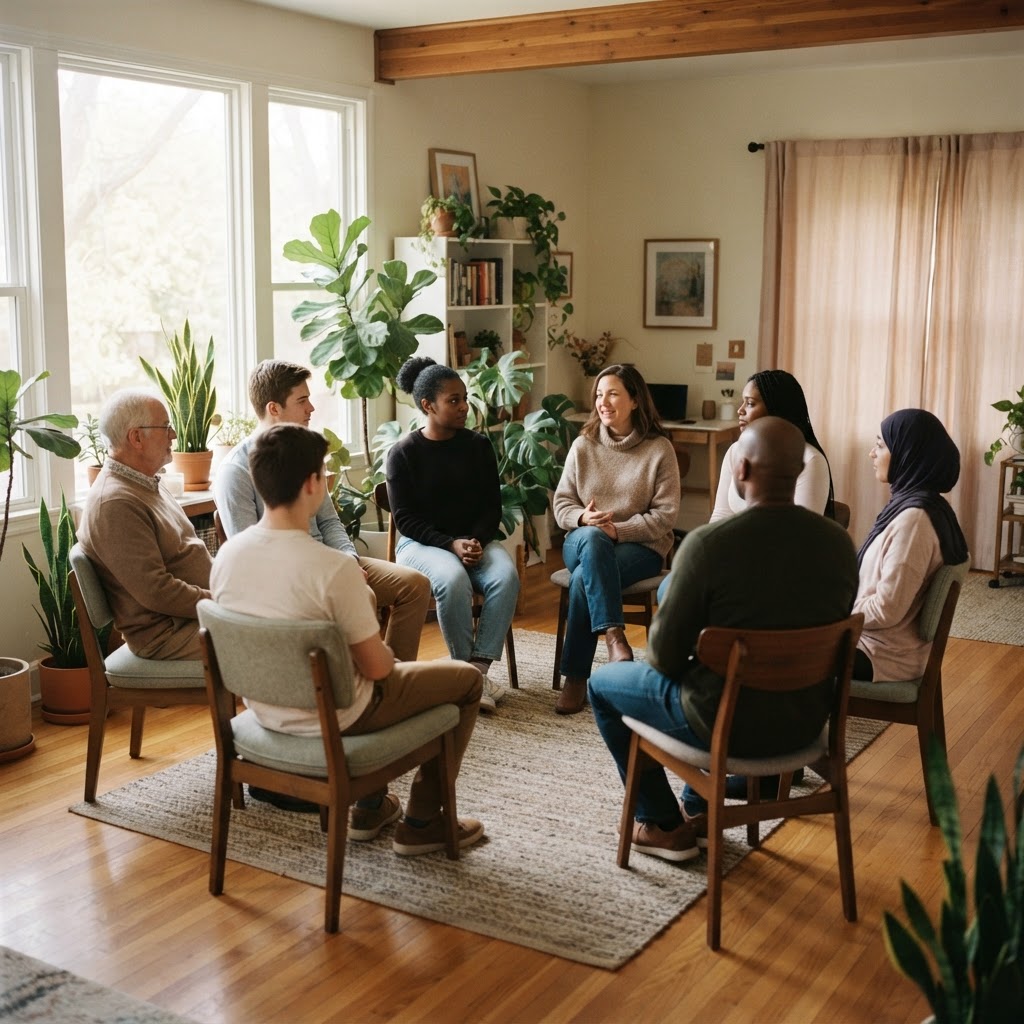
Some healing can only happen in the company of others. Here's why group therapy is one of the most powerful — and most overlooked — forms of trauma recovery.
The Healing You Can't Get Alone: Why Group Therapy Works
There's a particular kind of pain that comes from believing you're the only one. The only one who had that childhood. The only one who can't seem to keep it together. The only one carrying that secret.
Individual therapy can help you understand that story. But group therapy is where you discover you were never alone in it — and that discovery, in itself, is healing.
Why group work is different
Individual therapy is invaluable. But it has a built-in limitation: it happens between two people, in private, with one of those people being a trained professional. It can help you understand your patterns, but it can't always re-experience and repair them in real time.
Group work puts you in the room with other humans — people who trigger you, reflect you, surprise you, and ultimately, help you see yourself more clearly. The group becomes a living mirror and a safe laboratory for connection.
What actually happens in the healing power of a group
1. You realize you're not the only one
Shame thrives in isolation. The moment you hear another person name the thing you've been carrying in secret, something loosens. "You too?" becomes one of the most healing sentences in the human language. Group work makes that sentence possible.
2. You're witnessed — fully
Many of us grew up without being truly seen. In a group, you get to share your story and have it received by multiple people at once — without judgment, without fixing, without someone turning the conversation back to themselves. Being witnessed in your pain is a form of repair that individual therapy can't fully replicate.
3. You practice being real with people
Trauma teaches us to hide. To perform. To shape-shift depending on who's in the room. Group therapy gives you a place to practice the opposite: showing up as you actually are, and discovering you're still accepted. That's not a small thing. For many, it's the first time they've experienced it.
4. You learn you can help others — and that helps you
Something remarkable happens when you offer support to someone else in the group: you begin to trust your own wisdom. You start to see that the thing you survived gave you something to offer. That reframe — from broken to resource — can be life-changing.
5. You repair relational wounds in real time
If you get triggered by another group member (and you will), you get to work through it with them — in the moment, with support, instead of shutting down or walking away. This is practice for doing the same thing with your partner, your family, your friendships. Group therapy is, in many ways, a rehearsal for healthier relationships.
Common fears — and why they're worth pushing through
"I won't be able to handle hearing other people's stories." It's true that group work can be emotionally intense. But skilled facilitators pace the group carefully, and you're never forced to go beyond what your nervous system can hold. Many people find that hearing others' stories ultimately makes their own feel more bearable.
"What if I don't fit in?" This fear usually comes from a very old wound — the feeling of being on the outside. Group therapy is one of the few places specifically designed to help you work through exactly that. You don't have to arrive already belonging. You learn to belong by showing up.
"I'm more of a private person." You'll never be pressured to share more than you want to. In fact, some of the most powerful moments in group work come from someone simply being present and listening. Your presence matters even before your words do.
Group work + clinical therapy: the best of both
The most effective healing often comes from combining both: individual therapy to do the deep, personal work, and group work to practice and integrate it in community. At Restore Retreats, we've built our model on exactly this combination — because the research is clear, and so is our experience: people heal faster, deeper, and more durably when they do it together.
Restore Retreats blends clinical therapy with the power of group healing. Explore our retreats to find a space where you don't have to heal alone.